
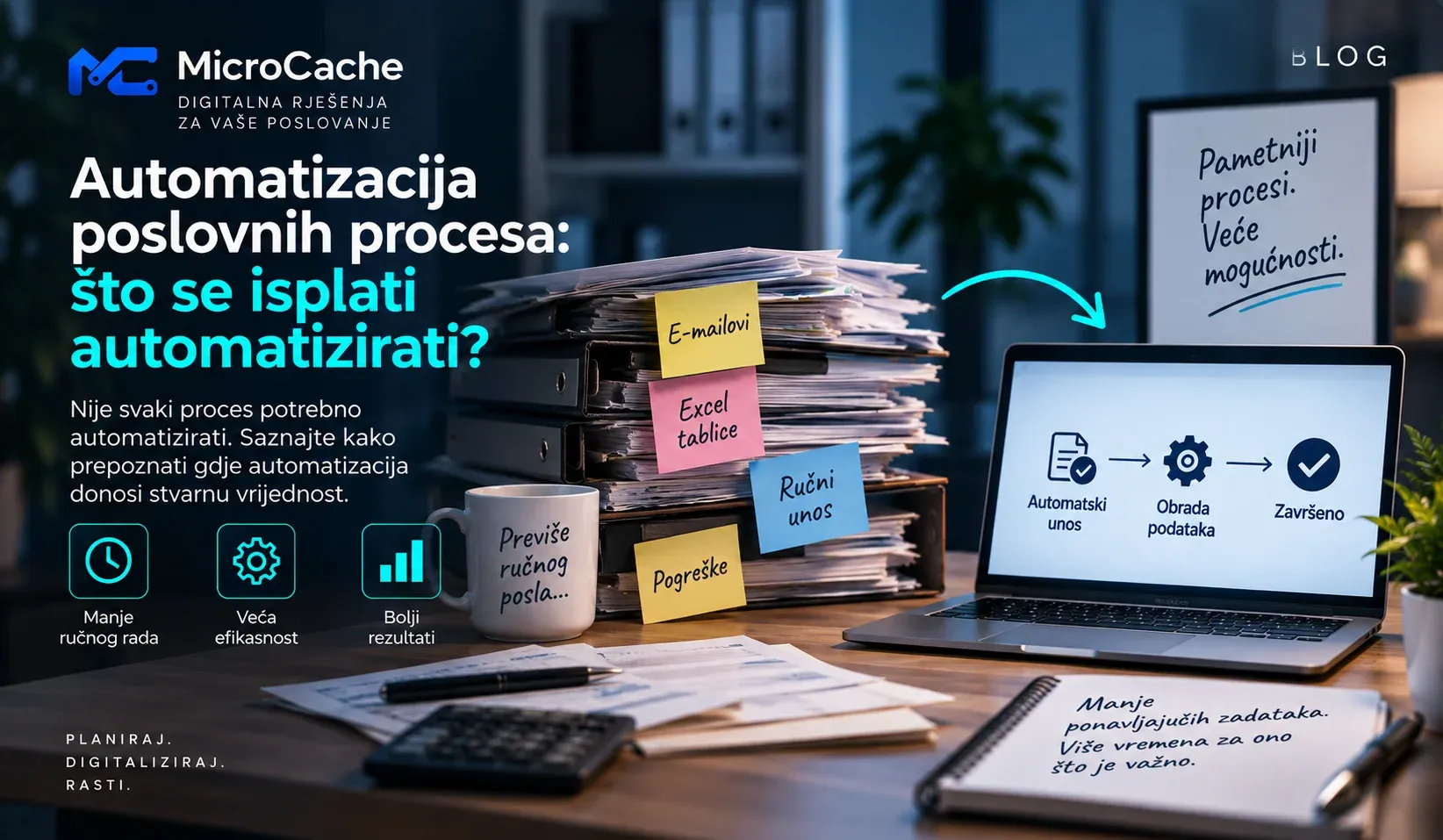
Business Process Automation: What Is Worth Automating?
Business process automation does not mean replacing every manual activity with software or artificial intelligence.
The more useful question is:
Which processes regularly consume employee time but could be performed more efficiently?
Where should you look first?
Good candidates for automation often share several characteristics.
Repetitive data entry
An employee receives information by email, in a document, or through one system and manually enters it into another.
Customer orders being entered into an ERP are one example.
If this happens dozens of times each day, it is worth investigating whether part of the workflow can be automated or the systems connected directly.
Manual document processing
Orders, forms, reports, and other documents often follow a similar workflow:
document → read → extract information → verify → enter into system
Parts of this process may be automated while employees remain responsible for reviewing uncertain or important cases.
Moving information between disconnected systems
ERP, CRM, ecommerce, and other business applications may work well individually while employees manually transfer information between them.
In this situation, integrating existing systems may provide more value than developing another application.
Manually tracking work status
If employees rely on calls, messages, and spreadsheets to determine the status of work, a digital workflow can provide clearer visibility into progress and responsibilities.
Digital work orders are one example.
How do you determine whether automation is worth it?
Start by measuring the current process.
For a selected workflow, determine:
- how frequently it occurs each month
- how much employee time it requires
- how many people are involved
- how often errors or rework occur
- which systems and documents are involved
If a task takes 15 minutes but occurs only a few times per year, automation is unlikely to be a priority.
If the same task happens hundreds of times each month, the economics can be very different.
Automation does not necessarily mean AI
Structured data can often be handled using API integrations, business rules, or capabilities already available in existing software.
AI becomes more relevant when a process involves emails, documents, free text, or other information that is difficult to process using fixed rules.
The right solution may combine several approaches.
Start with one measurable process
Instead of trying to automate an entire company, select one process with a clearly defined problem.
Measure the current workflow, implement a limited solution, and compare the results.
If the benefits justify implementation and maintenance costs, the same approach can gradually be expanded to other processes.
At MicroCache, we help companies analyse existing workflows and determine where automation, integration, or AI can make business sense.