
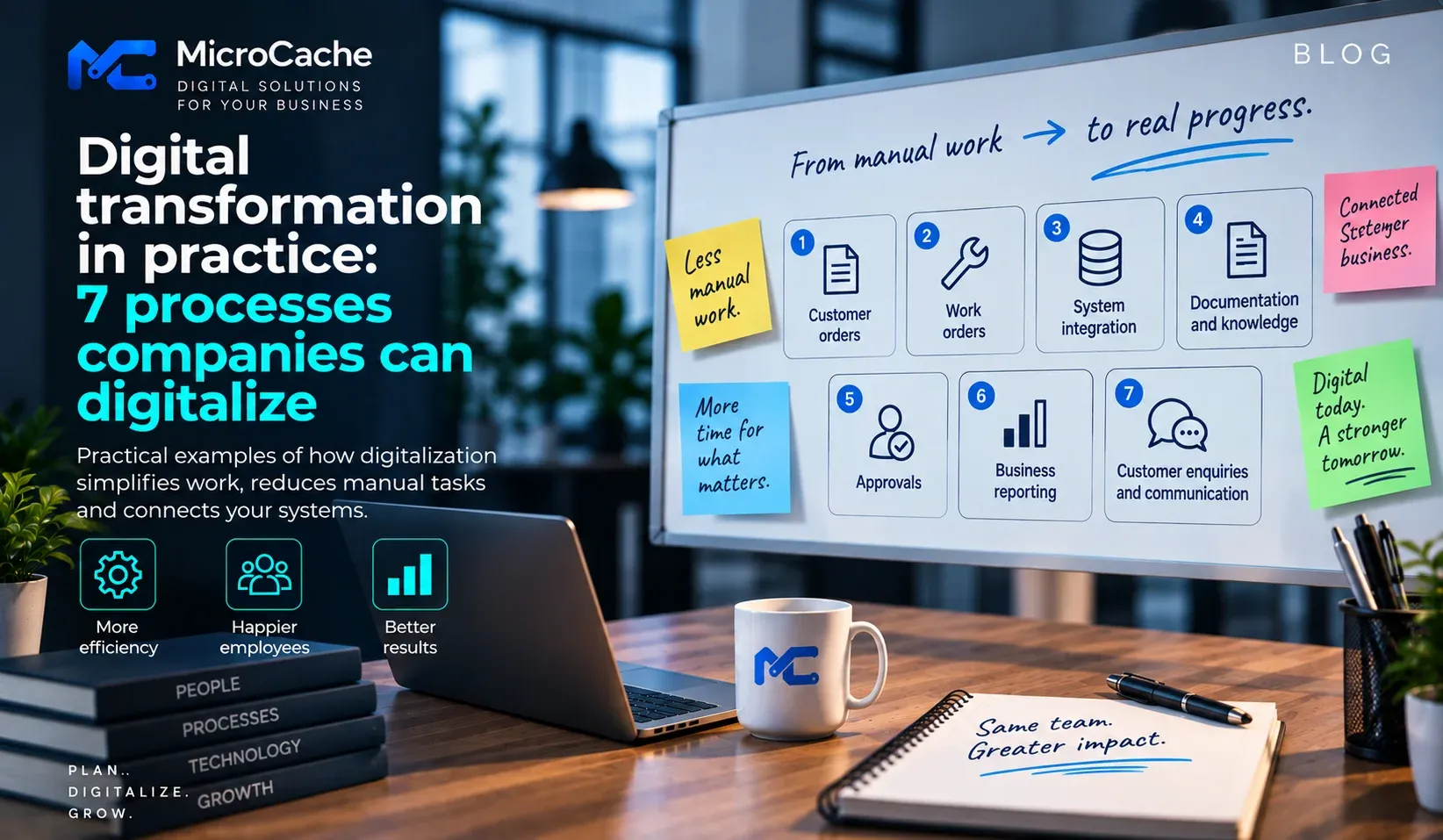
Digital Transformation in Practice: 7 Processes Companies Can Digitalize
Digital transformation can sound like a large project requiring companies to replace existing software and change their entire operation.
In practice, it can start much smaller.
A company can select one process that currently requires significant manual work and improve it using existing systems, integrations, automation, or AI.
Here are seven practical examples.
1. Customer order processing
Orders frequently arrive through email, PDF documents, or spreadsheets.
Instead of manually entering every field, relevant information can be extracted, verified, and prepared for an ERP or another business system.
Employees can then spend more time reviewing exceptions and less time on repetitive data entry.
2. Work orders
Paper, spreadsheets, and messages are still commonly used to coordinate service and field operations.
A digital work order can bring assignment, status, photos, notes, and job completion into one structured workflow.
3. Data exchange between business systems
ERP, CRM, ecommerce, inventory, and other applications often contain related information.
If employees manually transfer data between these systems, it is worth investigating whether they can be integrated.
Digitalization sometimes means connecting existing tools rather than replacing them.
4. Internal documentation and knowledge
Procedures, technical documentation, instructions, and other company knowledge may be spread across multiple folders and systems.
Centralized search and AI assistants can make relevant information easier to find while respecting appropriate access permissions and providing verifiable sources.
5. Approvals
Purchase requests, documents, proposals, and other decisions can be delayed when employees do not know who should take the next step.
A digital workflow can clearly define responsibility, status, and the next required action.
6. Business reporting
If an employee manually collects information from several systems every week to prepare the same report, parts of that process may be suitable for automation.
Reliable data sources should always be clearly defined.
7. Customer enquiries and internal communication
Recurring questions from customers or employees can require teams to repeatedly search for the same information.
Depending on the workflow, information can be centralized, searched, or used to prepare responses for employee review.
Where should you start?
Do not try to digitalize everything at once.
Choose a process that:
- occurs frequently
- requires significant manual work
- involves multiple systems or documents
- has a clearly measurable beginning and outcome
Then map the existing process and measure how much time and work it currently requires.
Digital transformation is not the objective by itself.
Value is created when technology removes unnecessary work, connects information more effectively, or provides employees with a simpler way to work.
At MicroCache, we help companies analyse existing processes and determine where digitalization, automation, integrations, or AI can provide practical business value.