
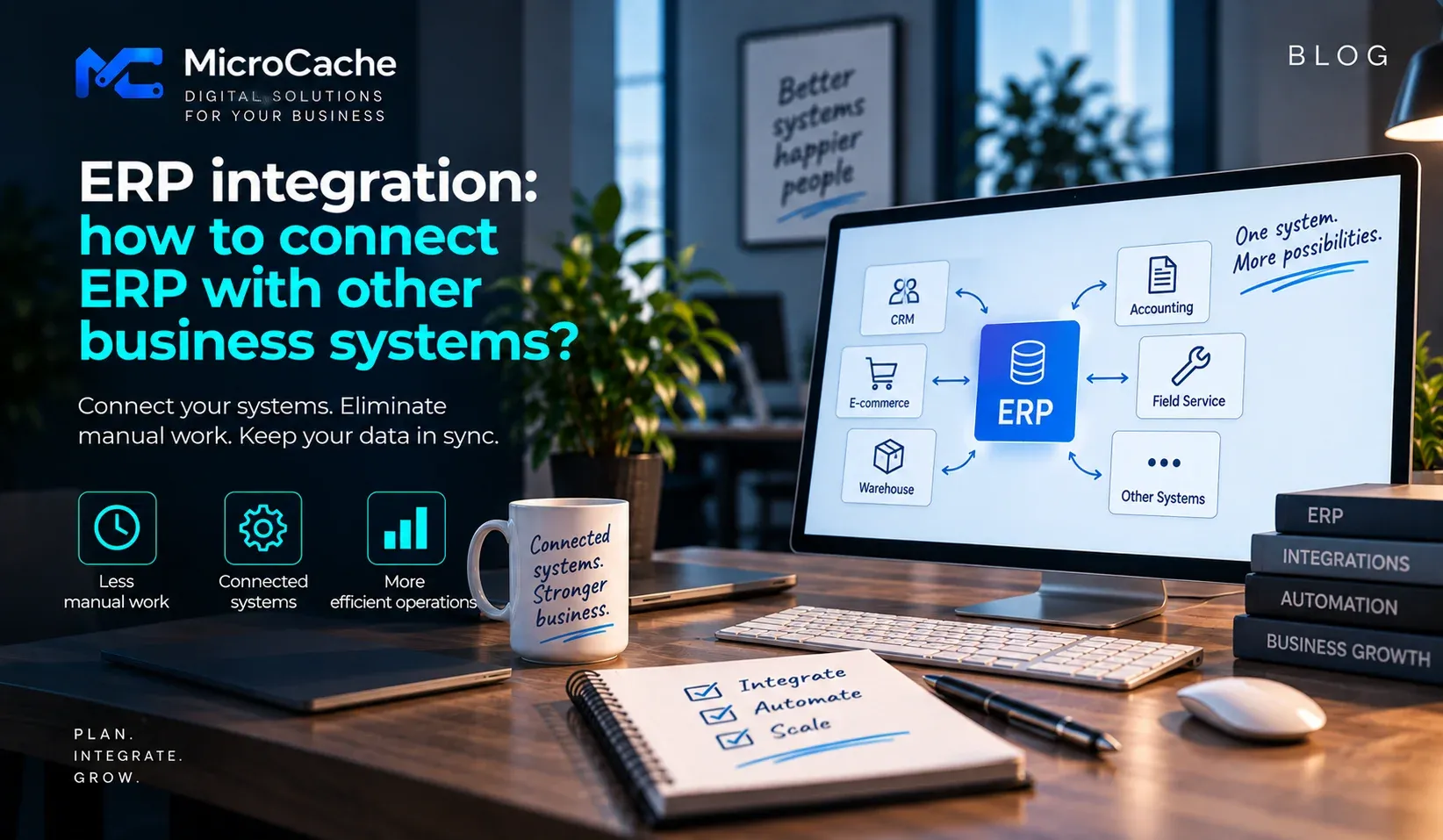
ERP Integration: How to Connect ERP With Other Business Systems
ERP is often one of the most important systems in a company, but it is rarely the only one.
A business may also use CRM, ecommerce, inventory software, mobile applications, work order systems, and other tools.
Problems appear when employees need to manually transfer information between them.
What is ERP integration?
ERP integration allows data to move between an ERP and other business systems.
For example:
Ecommerce → order → ERP
or:
CRM → customer → ERP → information required for further processing
The goal is to reduce unnecessary duplicate data entry.
What can be connected to an ERP?
Depending on the business and the capabilities of the existing ERP, integrations may include:
- CRM
- ecommerce
- inventory systems
- work order systems
- mobile applications
- order processing
- other internal applications
How are ERP systems integrated?
The best approach depends on the specific ERP.
Modern systems often provide APIs. Others may support file exchange or different integration mechanisms.
Before development begins, it is important to understand what the existing ERP officially supports and which data needs to move between the systems.
When does ERP integration make sense?
A strong signal is when employees copy the same information between multiple applications every day.
An integration can reduce manual data entry and allow information to reach the systems that need it more efficiently.
ERP integration does not necessarily mean replacing existing business software.
Often, the objective is the opposite: connect systems that already perform their individual jobs well.
At MicroCache, we build integrations between business systems based on the capabilities of existing software and the specific process a company wants to improve.