
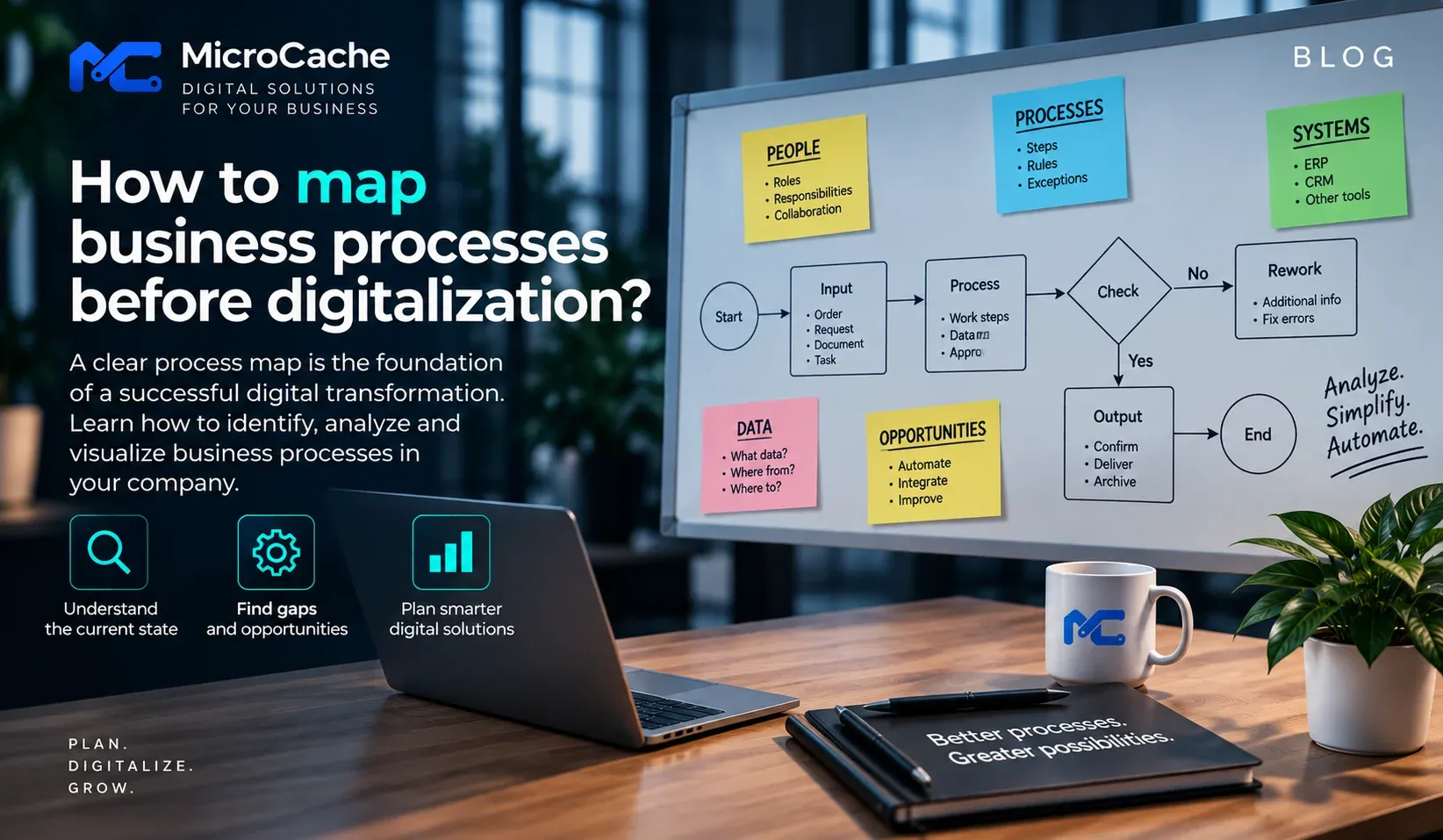
How to Map Business Processes Before Digitalization
A company wants to digitalize its operations. The first idea is often to find new software, introduce AI, or automate existing tasks.
Before choosing the technology, however, it is important to understand how the work actually gets done.
This is where business process mapping starts.
What is business process mapping?
Process mapping means documenting the important steps between the beginning and end of a business activity.
Consider a simple order process:
Customer sends an order → employee verifies the information → data is entered into the ERP → availability is checked → order is confirmed → delivery begins
The goal is not only to document the official procedure.
It is important to understand what happens in everyday work:
- Who performs each step?
- What information is required?
- Which systems are involved?
- Where is data entered manually?
- Where does the process wait for another person?
- Where do mistakes frequently occur?
These details often reveal the best opportunities for digitalization.
Why shouldn't automation come first?
Automating a poorly designed process can simply make unnecessary steps happen faster.
For example, an employee may manually transfer information between two systems because those systems are not connected.
The solution may not require a new application or AI.
A reliable integration between the existing systems might be enough.
The problem should therefore be understood before the technology is selected.
How do you map a process?
Start with one specific process that happens frequently.
Then document:
1. What starts the process?
A customer order, enquiry, service request, document, or another event.
2. What are the individual steps?
Follow the process from beginning to end, including manual checks and approvals.
3. Who is involved?
Identify employees, departments, and external participants.
4. Which systems are used?
ERP, CRM, Excel, email, documents, or specialized applications.
5. Where does unnecessary work occur?
Pay particular attention to duplicate data entry, waiting, manual information searches, and steps that frequently require corrections.
What happens after the process is mapped?
Once the existing workflow is clear, it becomes easier to decide what should change.
Some steps can be removed. Others can be connected through integrations. Some can be automated using simple rules, while AI may be useful when employees work with documents and other unstructured information.
The objective of digitalization is not to introduce as much technology as possible.
The objective is to create a simpler and more efficient business process.
At MicroCache, we analyse existing business processes and help companies identify where digitalization, automation, and system integration can create practical value.