How Can AI Use a Company's Internal Documents?
Most companies already possess a large amount of valuable knowledge.
The problem is that this knowledge is often spread across PDF files, Word documents, internal procedures, SharePoint, Google Drive, knowledge bases, and business applications.
AI can help employees find and use this knowledge more efficiently.
Instead of manually opening folders and searching through documents, an employee can ask a question in natural language and receive an answer based on relevant internal sources.
What does this look like in practice?
Imagine a company with hundreds of internal procedures.
An employee wants to know:
What is the process for handling a product complaint after delivery?
Without an AI system, they may need to find the correct folder, open several documents, and manually search for the relevant section.
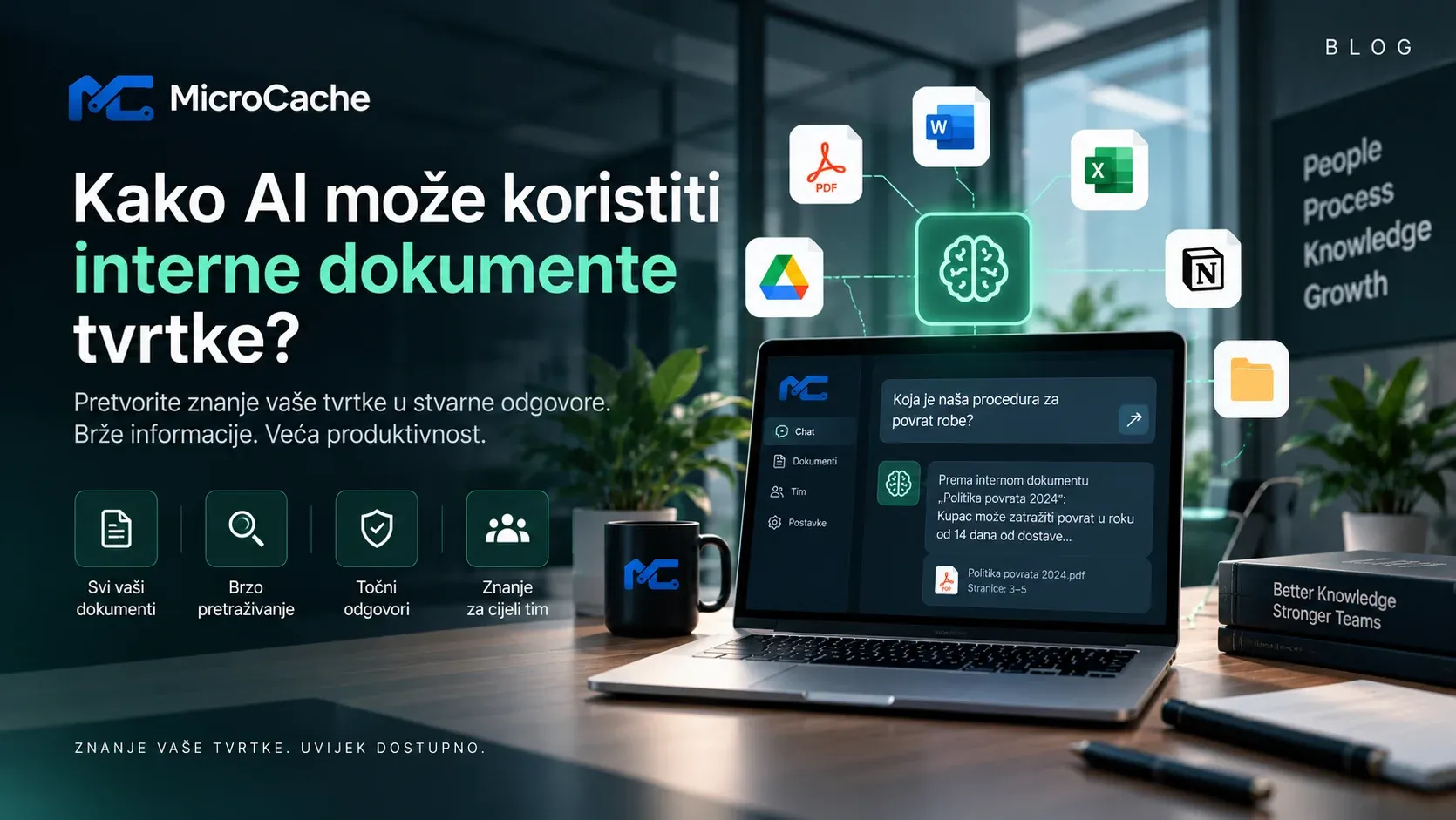
An AI system connected to internal documentation can search available sources, identify the most relevant passages, and generate an answer based on them.
A well-designed system should also show where the information came from.
For example:
According to the document "Customer Complaint Procedure 2026", the complaint must be recorded within two business days.
The employee can then open the original document and verify the information.
How does AI actually find the information?
The AI model does not need to learn every company document in advance.
A common approach is called retrieval-augmented generation, or RAG.
In simplified form, the process looks like this:
Employee question → search relevant documents → retrieve useful passages → AI generates an answer
Documents can first be processed and indexed so the system can quickly find content that is semantically related to a question.
The model then receives the relevant context when the user asks something.
What documents can AI use?
It depends on the company's infrastructure and requirements.
Common sources include:
- PDF documents
- Word documents
- Excel files
- internal procedures
- technical documentation
- company policies
- contracts
- price lists
- knowledge bases
- SharePoint
- Google Drive
- Microsoft OneDrive
- Notion
- CRM and ERP systems
- internal databases
- custom business applications
There is usually no need to connect every source at once.
It is often better to start with one clearly defined collection of documents and determine whether the system provides measurable value.
Can AI use documents without training a new model?
Yes.
For most business use cases, training a custom large language model is unnecessary.
Documents can be connected to a knowledge retrieval system, and relevant content can be provided to the model when a user asks a question.
This has several advantages.
Documents can be updated without retraining the model, access to sources can be controlled more easily, and answers can be linked to specific documents.
For this reason, RAG is often more practical than training a model on an organization's complete document collection.
What happens when a document changes?
This is an important part of a business implementation.
If a procedure changes, the AI system should not continue using an outdated version.
The system therefore needs a way to:
- re-index modified documents
- remove deleted documents
- track versions
- define approved sources
- determine which document takes priority when multiple versions exist
The quality of AI answers depends directly on the quality and freshness of the sources being used.
How is document access controlled?
AI should not bypass existing access permissions.
If an employee is not allowed to open a particular contract or financial document, they should not be able to access its contents through an AI chat interface.
Access control therefore needs to be part of the system design.
The system can use existing user accounts, groups, departments, or other rules already used by the organization.
For example, HR documents may only be available to the HR team, while technical procedures may be accessible to production and maintenance employees.
What are the most useful applications?
One of the simplest and most valuable applications is an internal AI knowledge assistant.
Employees can ask questions such as:
Where can I find the device service procedure?
What are the terms in our standard contract?
What is our onboarding process for a new employee?
What are the technical specifications for product X?
What is the latest approved version of our security procedure?
AI becomes a layer between employees and a large amount of company knowledge.
Where does the biggest value come from?
The biggest value is often not having AI create completely new content.
It is helping employees find information that already exists.
If ten employees each spend ten minutes every day searching for documentation, a company can lose a significant amount of time over the course of a year simply finding information.
AI can reduce this problem, especially in organizations with large amounts of procedures, technical documentation, or frequently repeated internal questions.
When does this kind of system make sense?
AI connected to internal documents makes sense when:
- employees frequently search through large amounts of documentation
- the same questions are repeatedly asked across teams
- documents are distributed across multiple locations
- faster onboarding of new employees is important
- answers need to be grounded in approved sources
- the organization wants to retain control over its business knowledge
If a company only has a small number of documents that employees can already find easily, such a system may provide limited additional value.
How do you get started?
A good first step is to select one document collection and one group of users.
For example:
The technical team frequently searches through 500 service and technical documents.
This is specific enough to measure how much time AI saves and whether the answers are useful.
MicroCache develops private AI solutions that connect business documents, knowledge bases, and internal systems with AI assistants.
The goal is not simply to enable conversations with documents, but to create a system that uses the right sources, respects access permissions, and fits the way the company already works.