What Is Private AI and How Does It Work in a Company?
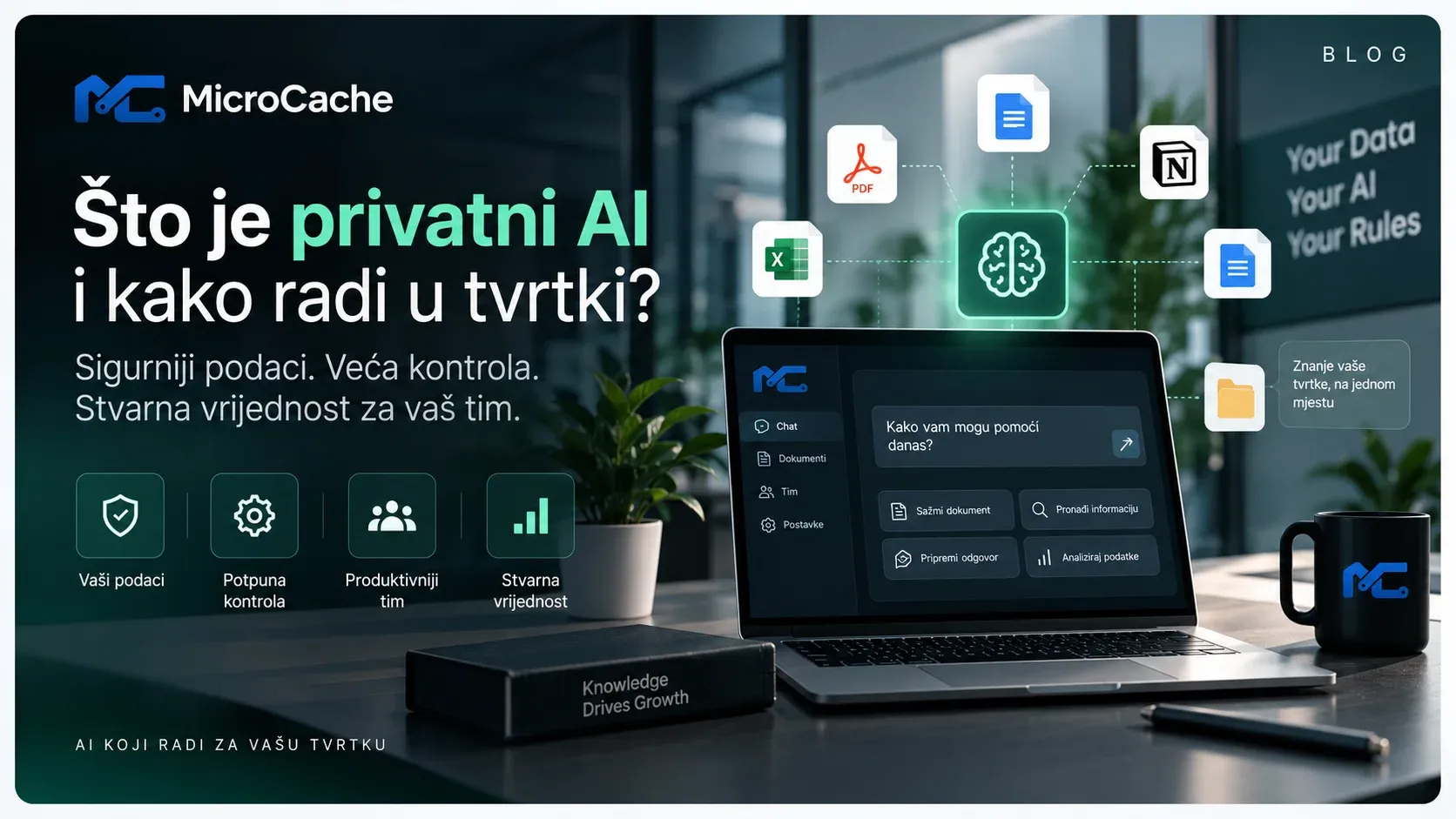
Private AI is an artificial intelligence system designed to give an organization greater control over its data, infrastructure, and the way employees use AI.
Unlike using a public AI tool only through its web application, a private AI environment can be connected to a company's internal documents, knowledge bases, and business systems. Depending on the requirements, models and other components can run in a private cloud or on infrastructure controlled by the company itself.
The goal is not to have AI simply because it is private. The goal is to enable employees to use AI with business knowledge and processes while maintaining a level of control appropriate for the organization.
What does private AI look like in practice?
Imagine a manufacturing company with hundreds of technical documents, procedures, instructions, and specifications.
Today, an employee might need to know which folder contains a document, open several PDFs, and find the relevant section.
With a private AI assistant, they could ask:
What is the quality control procedure for product X?
The system can then find relevant sections of approved documentation and use them to generate an answer.
A good system should not simply generate an answer. It should also show which documents the information came from so the employee can verify the source.
This is an important difference between an AI assistant that knows general information and an AI assistant that can work with an organization's specific knowledge.
What components make up a private AI system?
The implementation depends on the company, but it typically includes several components:
- an AI model that understands questions and generates answers
- an application through which employees use AI
- a system for searching internal knowledge
- data sources such as documents and business applications
- authentication and access permissions
- the infrastructure on which the components run
In simplified form:
Employee → private AI → knowledge search → internal sources
This means the AI does not need to contain all of the company's knowledge within the model itself. Instead, relevant information can be retrieved when an employee asks a question.
Does private AI have to run on your own server?
No.
"Private" does not automatically mean a server physically located in your office.
There are several possible deployment models:
On-premises
The model and data run on the company's own infrastructure.
Private cloud
The system runs in an isolated cloud environment controlled by the organization.
Hybrid approach
Part of the system remains within private infrastructure, while external services are used for specific functions.
The right choice depends on data sensitivity, security requirements, required performance, existing infrastructure, and budget.
That is why private AI is not a single product or a single architecture.
What data can private AI connect to?
One of the most useful applications of private AI is connecting it to information the company already owns.
This can include:
- internal procedures
- technical documentation
- policies and regulations
- contracts
- price lists
- PDF and Office documents
- knowledge bases
- CRM and ERP systems
- internal applications
An important part of implementation is defining which sources the AI is allowed to use and which employees are allowed to access specific information.
If a user does not have permission to open a particular document, a well-designed AI system should not give them access to its contents simply because they asked a question through a chat interface.
When does private AI make sense?
Private AI becomes particularly useful when an organization wants to integrate artificial intelligence more deeply into its processes while maintaining greater control.
Examples include companies that:
- have large amounts of internal documentation
- work with confidential business information
- want control over where their data is processed
- have specific access control requirements
- want to connect AI to existing business systems
- have processes that are not covered by generic AI tools
For simple email writing, brainstorming, or occasional research, private infrastructure is often unnecessary. In these situations, ready-made cloud AI tools may be a simpler solution.
Private AI is more than an AI model
A common mistake is to reduce private AI to installing a local large language model.
The model is only one part of the system.
For business use, user management, permissions, document connections, search, security, monitoring, and integration with existing applications are often just as important.
The value of private AI therefore does not come only from where the model runs, but from how well the entire system fits the way the company actually works.
How do you get started?
The best starting point is usually not "let's introduce AI across the entire company."
It is better to identify one specific problem.
For example:
Employees spend too much time searching for procedures across large amounts of documentation.
A problem like this has a clear scope and makes it possible to determine whether AI provides real value before expanding it to other processes.
MicroCache develops private AI solutions and integrations tailored to a company's data, infrastructure, and business processes.
If you are considering private AI, the first step can be to assess a single process and determine whether you need a local model, a private cloud, or a simpler AI integration.